INTERVIEW WITH STEVE LIEBER
Di Marcello
Vaccari.
Supervisione e traduzione dall'Italiano all'Inglese di Max
Brighel e del suo studio.
Vai alla Versione Italiana.
1) Let's start saying that in Italy you are practically an unknown, and your first published work is Whiteout. That's, however, a big and beautiful visiting card. Could you summarize for us a little bit of your career?
I studied cartooning at the Joe Kubert school. After graduating, I illustrated a lot of different comics for American publishers such as DC, Marvel, and Dark Horse and Caliber. The most interesting stuff was at Dark Horse, where I worked with a wonderful writer named Jeffrey Lang on a Mary Poppins-ish character called "Nanny Katie" and on a Grendel Tales story.
2) Whiteout is an important turning point in your career. How did you find yourself involved in it? What do you like the most in this story?
Bob Schreck, who I'd worked with at Dark
Horse, asked me if I'd be interested in working on a crime comic. I said, "Ift's good, sure."
He gave me a copy of Greg Rucka's novel Keeper, which I devoured in a
day.
Reading it, I realized that Greg's writing wasn't just compelling, it also communicated a view of people and the world that was close to my
own. And he wrote pictures and scenes that played to my strengths as
an artist. I called Bob and told him that I'd love to work with this guy.
What I found in the script for issue one was a story that had
suspense, humor, great dialogue and visceral impact and that called for pictures
that I was absolutely aching to draw.
3) Did you have any problems illustrating it? It must not have been easy to draw the Antarctic.
Problems? No. It required more research than most projects I've worked on, but I love doing research. My main goal with the pictures, beyond making things correct, was capturing the feeling of the place, and of Greg's story. To that end, I just threw everything I had at the pages, working and reworking them with every technique I knew- home made ziptone screens, grease crayon, white paint spattering, slashing the page with razor blades, lunatic cross hatching, manipulating photocopies, anything at all, until I could feel the cold.
4) Did you completely follow Greg Rucka's script or added something yours?
I followed pretty closely, though I'd sometimes play with rhythm by adding or removing a panel, and the body language and camera work was almost all mine.
5) An intriguing question. Did they ever pay you any royalties for the Italian edition?
Not yet. Nor have I seen a copy of it.
6) Your Hawkman has never been translated in Italy, but I partly followed the American edition. Why was it cancelled? Your pencils were already very good, and I do remember I thought you would have surely started illustrating some major character after that. How come you didn't?
I didn't draw in a popular style, and there were plenty of other artists available who did.
7) How do you like working with DC or Marvel? Do you prefer working with small publishing houses like Oni Press?
It's not the publisher that makes an experience enjoyable so much as the project and the editor. I prefer working in black and white, by myself, rather than with an inker or letterer, on characters that I've created, on self-contained stories, with an editor who'll argue his opinions but not force changes. When I'm looking for these conditions, a company like Oni is ideal. Still, I've had some great experiences recently with DC on their Batman comics, and would happily do more with them.
8) I've seen your pages of Batman: Turning Points 1 and I liked them a lot. I think your work here is notably influenced by David Mazzucchelli's Batman Year One. Is it a natural evolution of your style, or the story inspired you the use of that particular style?
Mazzucchelli's influence there was huge and intentional. The story was subtitled "A Tale of Year One." I also thought about Attilio Micheluzzi, Alex Toth and Milton Caniff. I honestly don't think I'm evolving. I just try to change my style to fit whatever story I'm telling.
9) It seem to me your work is much
more effective in black and white than in color. What do you think about that? Not a long time ago, the
Batman: Black and white miniseries was a good success: don't you think
that it could be interesting to repeat this experiment, or have a regular series entirely in b/w? The American audience clearly prefer
color comics (unlike the Italian, well accustomed to b/w ones), but seeing the recent drop in sales, how come the Majors don't try a b/w
monthly? After all, your Whiteout was a good success!
I've tried for years to convince the
people I know at the big publishers to do more B&W. My work is cretainly better suited for it.
Unfortunately, outside of certain genres, such as crime, it's very difficult to get North American readers to buy a black and white comic
book, and the sales plunge when they try. Since the publishers still have to pay page rates to the creators, it becomes difficult to break
even, despite the lowered production costs.
10) Who are your favorite artists and who influenced you the most?
Cartoonist Influences: Joe Kubert, David Mazzucchelli, Alberto and Enrique Breccia, Milton Caniff, Alex Toth, Howard Chaykin, Alex Raymond, Jaime Hernandez
Other favorites: Chris Ware, Dan Clowes, Joe Sacco, Carla Speed McNeil, Charles Schulz, Tardi, Vittorio Giardinno, Depuy and Berberian,
Illustrators and painters: Bosch, Howard Pyle, N.C. Wyeth, J.C. Coll, Norman Rockwell, Degas, Hopper, The Ashcan school painters, Andrew Loomis, Robert Fawcett, C.D. Gibson.
12) I've noticed that you are very active on Internet. Do you think the 'Net is a big promotional mean or an obstacle to the sales like many are now thinking?
It's a great way to increase awareness of one's work, and I'm sure it's helped our slaes.
13) What do you have planned after Batman: Turning Point? Any chance we will see you drawing more Marvel characters?
I haven't spoken to anyone at Marvel for
a couple of years. My coming projects include these:
Warren Ellis and I are collaborating on a graphic novel to be
published by Image: MORNING DRAGONS.
Other upcoming projects include the following: A 54 page story about
the trial of Robert Oppenheimer for Jim Ottaviani's FALLOUT, an
anthology about the making of the atom bomb.
ME AND EDITH HEAD, a young adult story for Cicada magazine, written by
Sara Ryan featuring one of the characters from her novel EMPRESS OF
THE WORLD.
A western "Tales of the Slayer" story for a Buffy anthology,
written by David Fury, one of the show's writers.
A Harley Quinn story written by Karl Kesel.
And a horror/fantasy story for Michael Cohen's "The Forbidden
Book" written by Victoria Garcia and Sara Ryan.
Official Steve Lieber Site:
http://unrewarding.com/steve
The sequel, MELT won the Eisner award for Best Limited Series of 1999.
All Images of
Batman (c) D.C. Comics.
WHITEOUT (c) Greg Rucka & Steve Lieber
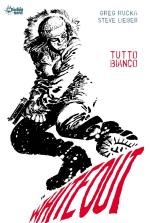
Cover of Whiteout, Italian Edition

A page of Whiteout
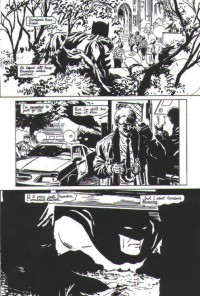
A page of Batman.

A very good Batman shot.
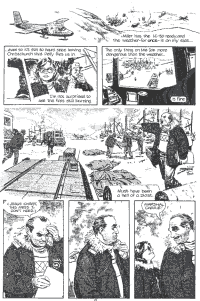
A page of Whiteout: Melt